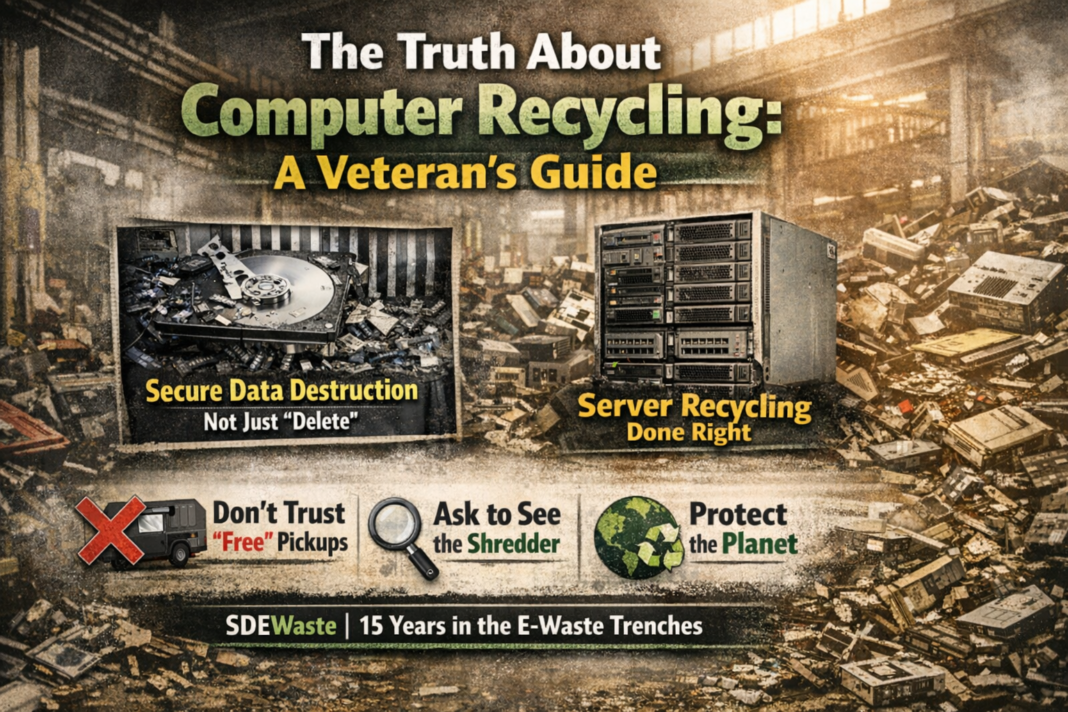

I’ve spent fifteen years smelling burning solder and dust. My hands have the scars to prove it. Most people think computer recycling is just throwing an old laptop into a blue bin. It isn’t. It’s a dirty, loud, and high-stakes game. If you screw it up, your data ends up on a marketplace in a country you can’t point to on a map.
The Smell of Stale Dust
Walk into any warehouse in the United States that handles e-waste. What do you smell? It’s a mix of ozone, ancient dust, and a hint of ozone. I’ve stood in those bays for a decade. I’ve seen mountains of “vintage” towers from 2005. Most of it is junk. But hidden in that junk is gold, silver, and enough toxic lead to ruin a local water table.
Here’s the thing. We live in a world that treats hardware like fast fashion. We buy, we break, we bury. But “burying” isn’t an option anymore. When I started, we just tossed things. Now? If I see a tech lead tossing a server into a standard dumpster, I lose my mind. It’s lazy. It’s dangerous.
Hard Drive Destruction: Don’t Trust the Delete Key
I once watched a guy try to “wipe” a batch of drives using a magnet he bought at a hardware store. I laughed until I realized he was serious.
Listen to me. Data is sticky. It clings to those platters like grease to a pan. If you want real security, you need Hard Drive Destruction that involves physical force. I’m talking about industrial shredders. The sound is terrifying. It’s a metallic scream as a machine chews through steel and magnets.
When the machine stops, you’re left with silver confetti. That’s the only time I sleep well. If you aren’t getting a certificate of destruction, you’re just giving your bank statements to a stranger. It’s that simple.
Server Recycling Is a Different Beast
Servers aren’t just big PCs. They’re heavy. They’re awkward. And they are packed with proprietary info. I’ve spent nights in cold server rooms, racking my knuckles against sharp rails while decommissioning racks. Server recycling requires a plan. You can’t just wheel them out the front door. You have to track every serial number. You have to pull the CMOS batteries. You have to strip the copper. I’ve seen companies like San Diego E-Waste handle this properly, and I’ve seen “junk haulers” drop a $10,000 blade array off the back of a truck. Total amateur hour.
The Data Destruction Myth
Software wipes are fine for your grandma’s laptop. For a business? No way. Data Destruction is a legal requirement, not a suggestion. I’ve sat through audits that would make your hair turn white. They want to know where every bit of silicon went.
I remember a project three years ago. A law firm thought they were being “green” by donating old towers to a local school. Great idea, right? Wrong. They didn’t scrub the drives. Six months later, I’m the one they called to track down thirty PCs scattered across the city. Nightmarish.
Why “Free” Is a Red Flag
If a company offers to take your e-waste for free, run. Seriously. Get out of there.
Recycling costs money. It takes labor to tear down a chassis. It takes electricity to run a shredder. If it’s free, they are making their money somewhere else. Usually, that means selling your “scrubbed” hardware to the highest bidder without actually cleaning it.
I’ve seen the “free” guys. They show up in a beat-up van, toss your gear in the back, and disappear. No paperwork. No accountability. Just a void where your security used to be.
The Environmental Gut-Punch
It’s not just about data. It’s about the poison.
Motherboards are toxic cocktails. Lead, mercury, cadmium. When these sit in a landfill, they leak. The rain carries that sludge into the soil. I’ve seen photos of “recycling” centers overseas where kids burn wire to get to the copper. The black smoke is thick enough to choke a horse.
We have to do better in the United States. We have the tech. We have the shredders. There is no excuse for shipping our poison to someone else’s backyard.
My Advice? Be Annoying.
Ask questions. Demand to see the facility. Ask about their downstream vendors. If they get defensive, they’re hiding something.
A real pro will show you their shredder with pride. They’ll explain how they separate plastics from precious metals. They’ll talk about “circular economies” without sounding like a marketing brochure.
Anyway, that’s my rant. Computer recycling isn’t glamorous. It’s hot, loud, and dirty work. But it’s the only thing standing between your private life and a catastrophic leak. Stop being lazy with your old tech. Treat it like the hazardous, data-filled bomb it actually is.
FAQ: The Quick Dirty on E-Waste
1. Can I just drill a hole in my hard drive? It’s better than nothing, but modern data density means a single hole leaves plenty of recoverable sectors. Shredding is the only way to be 100% sure.
2. Is it safe to donate my old computer? Only if you remove the hard drive first. Keep the drive, shred it, and donate the rest of the “hollow” machine.
3. What happens to the plastic? It gets ground down into pellets. Those pellets eventually become new printer housings or car parts. It’s a long process, but it works.
4. Does computer recycling include cables? Yes. Cables are copper goldmines. Never throw them away. They are the easiest thing to recycle.5. How do I find a legit recycler? Look for certifications like R2 or e-Stewards. Check reviews. If they’ve been around as long as I have, they’ll have a track record you can verify.