
Financial businesses handle numerous customer enquiries every day, from questions about banking services and insurance policies to loan applications and investment options. Responding to every enquiry manually can take considerable time and resources. An AI chatbot for financial services can help simplify these interactions by providing instant answers, sharing approved business information, and collecting potential customer enquiries.
Whether you operate a bank, fintech company, insurance agency, investment firm, or loan service, an AI-powered chatbot can improve customer communication and make routine support more efficient. In this article, we’ll explore how financial services chatbots work, their benefits, practical use cases, and how businesses can get started.
What Is an AI Chatbot for Financial Services?
An AI chatbot for financial services is a virtual assistant designed to answer customer questions and provide information about financial products and services. It uses artificial intelligence to understand natural language and generate relevant responses based on information provided by the business.
Unlike traditional chatbots that rely on fixed questions and answers, AI-powered chatbots can understand different ways of asking the same question and respond using their available knowledge.
Financial businesses can train these chatbots using approved website content, frequently asked questions, service descriptions, product brochures, and other business documents.
For example, a visitor on a bank’s website might ask about savings account features. The chatbot can share relevant information and direct the visitor to the appropriate page or customer support team.
Why Are Financial Businesses Using AI Chatbots?
Customer expectations are changing. People want quick answers and convenient ways to find information about financial products and services. AI chatbots help businesses meet these expectations while reducing repetitive work for their support teams.
Here are some important benefits.
1. Provide 24/7 Customer Support
Customers may visit a financial website outside regular business hours. An AI chatbot can answer common questions at any time, helping visitors access general service information without waiting for a representative.
2. Reduce Repetitive Enquiries
Financial businesses often receive similar questions about fees, documentation, application procedures, policies, and available services. A chatbot can handle many routine enquiries, allowing employees to focus on more complex customer requests.
3. Improve Customer Engagement
An AI chatbot can interact with website visitors, understand what information they need, and guide them toward relevant products, services, or resources.
4. Generate More Business Leads
Visitors researching loans, insurance plans, or financial services may be interested in speaking with a representative. A chatbot can collect their contact details and pass the enquiry to the appropriate team for follow-up.
5. Deliver Consistent Information
When trained on accurate and approved business content, a chatbot can provide consistent answers to common questions. Businesses should regularly review and update its knowledge to reflect changes in products, fees, and policies.
10 Practical Use Cases of AI Chatbots in Financial Services
An AI chatbot can support several customer communication activities across the financial industry. Here are ten practical applications.
1. Answering Banking Questions
Banks can use chatbots to answer general questions about account types, branch locations, operating hours, banking services, and published fees. Account-specific enquiries should be directed to secure banking channels.
2. Explaining Insurance Products
Insurance companies can use chatbots to share approved information about available policies, coverage options, documentation requirements, and general claim procedures.
3. Handling Loan and Mortgage Enquiries
Loan providers can use chatbots to explain different loan products, published eligibility criteria, required documents, and application steps. Visitors can also request a callback from a loan representative.
4. Sharing Investment Service Information
Investment and wealth management firms can use chatbots to explain their advisory services, consultation procedures, and general investment-related resources. Personalised investment recommendations should be handled by appropriately qualified professionals.
5. Capturing Potential Customer Leads
A chatbot can engage website visitors who are interested in financial products and collect relevant contact details. Sales teams can then follow up with prospective customers.
6. Guiding Customers Through Application Procedures
Financial businesses can use chatbots to explain how to begin an application, where to find forms, and which documents may be required.
7. Scheduling Consultation Requests
Investment firms, mortgage providers, and financial advisors can use chatbots to collect preferred consultation dates and contact information. Actual appointment confirmation depends on the available scheduling system.
8. Sharing Frequently Asked Questions
A chatbot can answer common questions about service availability, pricing, fees, policies, business hours, and contact information using approved content.
9. Directing Customers to the Right Department
When a customer has a question that requires personal assistance, the chatbot can guide them toward the relevant department or human representative.
10. Supporting Multilingual Communication
Financial businesses serving customers across different regions can consider multilingual chatbot capabilities to make general service information easier to access. Translated financial content should be reviewed for accuracy.
How Different Financial Businesses Can Benefit From AI Chatbots
AI chatbots can support different types of financial organisations, although their requirements and customer workflows may vary.
Banks and Financial Institutions
Banks can use chatbots to answer general questions about banking services, explain account-opening procedures, share branch information, and direct customers to secure support channels.
Fintech Companies
Fintech businesses can use chatbots to explain platform features, answer onboarding questions, provide product information, and capture enquiries from prospective users.
Insurance Companies
Insurance providers can use chatbots to explain policy features, share general information about coverage, guide visitors through claim procedures, and collect enquiries from potential policyholders.
Investment and Wealth Management Firms
Investment firms can use chatbots to introduce their services, explain consultation processes, answer general questions, and connect prospective clients with qualified advisors.
Loan and Mortgage Providers
Loan providers can use chatbots to explain loan options, share document checklists, answer general application questions, and collect contact details from interested borrowers.
How to Train an AI Chatbot for Financial Services
The quality of a chatbot’s responses depends heavily on the information used to train it. Financial businesses should ensure that the chatbot relies on accurate, approved, and regularly updated content.
Here are some steps to consider:
- Prepare your website content: Use relevant pages explaining your financial products, services, fees, and business policies.
- Add frequently asked questions: Include common customer questions and approved answers.
- Upload relevant documents: Add suitable product brochures, service guides, and other approved documents.
- Set clear instructions: Define what the chatbot can answer and which questions require human assistance.
- Establish response boundaries: Prevent the chatbot from making unsupported promises or providing personalised financial advice.
- Test its responses: Ask realistic questions to identify inaccurate or incomplete answers.
- Update the knowledge base: Review and refresh information whenever products, policies, fees, or procedures change.
Training a chatbot on approved business information can help it provide more relevant responses while keeping its role clearly defined.
Financial Chatbot Security and Data Privacy Considerations
Financial conversations can involve sensitive personal and account information. Therefore, businesses should consider privacy and security before introducing an AI chatbot.
Important considerations include:
- Limit data collection: Only request information that is genuinely necessary for the enquiry.
- Protect sensitive details: Avoid asking customers to share passwords, PINs, full card numbers, or account credentials in a general website chat.
- Review data storage: Understand how conversation data is collected, stored, accessed, and retained.
- Check third-party providers: Review the chatbot provider’s security practices, data processing terms, and relevant vendor arrangements.
- Provide transparent notices: Explain how customer information may be used.
- Establish human escalation: Direct sensitive requests, suspected fraud, and account-related problems to appropriate secure channels.
Businesses should also review the privacy and financial regulations applicable to their locations and services. A chatbot platform alone does not guarantee regulatory compliance.
Why Human Support Is Still Important
Although AI chatbots can handle routine enquiries, they should not replace human professionals in every situation.
Some financial questions require personal judgement, additional verification, or specialised expertise. For example, customers may need assistance with suspected fraud, disputed transactions, complaints, financial hardship, or personalised investment decisions.
A well-designed chatbot should recognise when it cannot provide a reliable answer and direct the customer to the appropriate representative.
Combining AI automation with human support helps financial businesses provide convenient communication without removing the personal assistance customers may need.
AI Chatbots Across Other Industries
Although financial services have specific communication and compliance requirements, AI chatbot technology is also useful in other industries.
- AI chatbot for travel: Travel companies can use chatbots to answer questions about destinations, travel packages, booking procedures, and cancellation policies.
- AI chatbot for service businesses: Service providers can automate enquiries about their offerings, pricing, availability, and appointment requests.
- AI chatbot for veterinary clinics: Veterinary clinics can use chatbots to share clinic hours, explain available services, collect appointment requests, and answer general pet-care service questions.
These examples demonstrate how businesses across different industries can use AI chatbots to improve customer communication and manage routine enquiries.
How to Choose the Right AI Chatbot for Financial Services
Selecting the right chatbot platform is important for delivering a useful and reliable customer experience.
Before choosing a solution, consider these features:
- AI training: The platform should allow you to train the chatbot using website content, FAQs, and approved documents.
- Customisation: Look for options to customise its appearance and communication style to match your brand.
- Lead capture: Choose a chatbot that can collect prospective customer contact details through conversations.
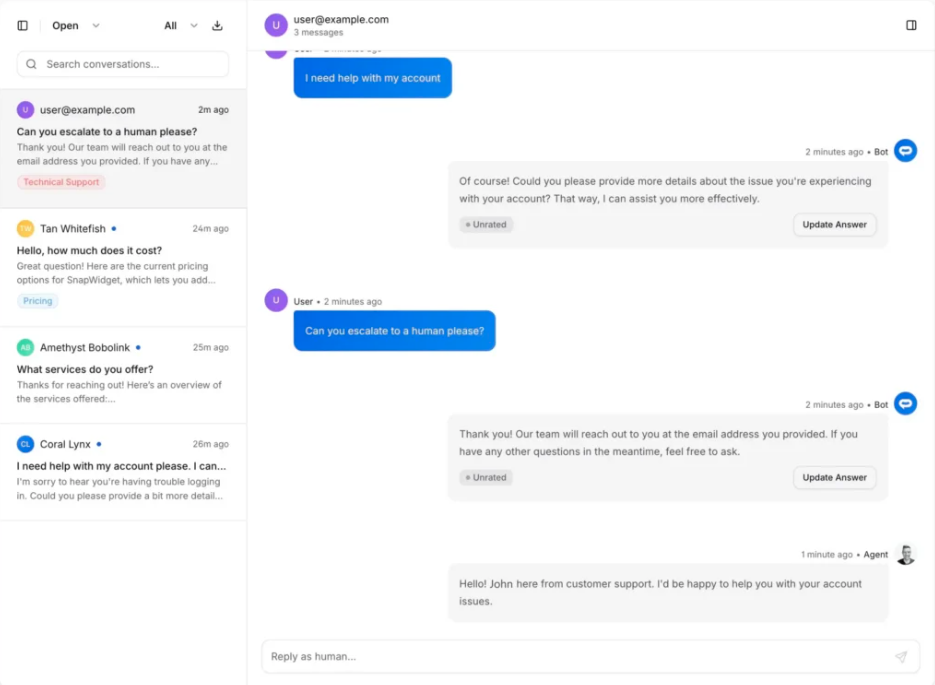
- Human handoff: Make sure customers can reach a human representative when necessary.
- Analytics: Look for reporting features that help you understand conversation trends and identify unanswered questions.
- Integrations: Check whether the platform supports the CRM, helpdesk, and other systems your business needs.
- Privacy and security: Review the provider’s data handling, access controls, retention practices, and security documentation.
- Pricing and scalability: Select a solution that fits your current requirements and can support future growth.
How AI-Chatbot.ai Can Help Financial Services Businesses
AI-Chatbot.ai helps businesses create and customise AI chatbots without requiring advanced technical expertise. Financial service providers can use the platform to build a website assistant that answers routine questions, shares approved business information, and engages potential customers.
With AI-Chatbot.ai, businesses can explore capabilities such as:
- AI training: Train a chatbot using website content, FAQs, and relevant business documents.
- Lead capture: Collect contact information from visitors interested in financial products and services.
- Customisation: Adjust the chatbot’s appearance to align with your company’s branding.
- Inbox and live chat: Manage conversations and provide human assistance when needed.
- Analytics: Review chatbot interactions and identify opportunities to improve responses.
Whether you operate a fintech company, insurance agency, financial advisory firm, or lending business, an AI chatbot can help make routine website communication more efficient.
Explore AI-Chatbot.ai’s financial services chatbot solution to learn how you can introduce an AI assistant to your business.
Frequently Asked Questions
What is an AI chatbot for financial services?
An AI chatbot for financial services is a virtual assistant that uses artificial intelligence to answer customer questions, share financial product information, guide visitors through general processes, and collect enquiries.
How can banks use AI chatbots?
Banks can use AI chatbots to answer frequently asked questions, share information about banking services, explain account-opening procedures, and direct customers to appropriate support channels.
Are AI chatbots safe for financial services?
They can support customer communication when deployed with appropriate privacy, security, access controls, and data-handling practices. Businesses should avoid collecting unnecessary sensitive information and review applicable regulatory requirements.
Can AI chatbots generate leads for financial companies?
Yes. Chatbots can engage website visitors, answer product questions, collect contact details with appropriate consent, and pass enquiries to sales representatives.
Can an AI chatbot provide financial advice?
A general-purpose chatbot should not be treated as a substitute for a qualified financial professional. Personalised investment, tax, or other regulated advice should be handled by appropriately qualified professionals.
Can small financial businesses use AI chatbots?
Yes. Smaller financial businesses can start with straightforward use cases such as answering FAQs, explaining services, collecting enquiries, and requesting consultations without necessarily building complex banking integrations.
An AI chatbot for financial services can help banks, fintech companies, insurance providers, investment firms, and loan businesses improve customer communication and automate routine enquiries. From sharing approved product information to capturing potential customer leads, chatbots offer practical ways to make website interactions more convenient.
The key is to implement a chatbot with clear responsibilities, reliable business information, appropriate privacy safeguards, and access to human support when needed.
With a suitable platform such as AI-Chatbot.ai, financial businesses can take a practical first step toward improving customer engagement and managing website enquiries more efficiently.